
Best Privacy Management Platforms in 2026

Keeping a privacy program on track is not just about having the right policies on paper, it is about running hundreds of small operational tasks without dropping any of them.
Most privacy leaders spend their week moving between Records of Processing Activities (RoPA), DPIAs and TIAs, vendor assessments, and data subject request (DSR/DSAR) queues. On top of that, they are expected to keep up with new regulations, coordinate with security and engineering, and now maintain an inventory of AI systems as well. Trying to manage all of this with spreadsheets, shared drives, and email threads quickly becomes unmanageable.
Privacy management platforms exist to bring this work into one place. A good platform helps you:
- Maintain a live data map and RoPA
- Standardize DPIAs, PIAs, TIAs and other assessments
- Automate DSR intake and fulfilment
- Keep a third-party and vendor risk register audit ready
- Track AI use cases and risk across the organisation
- Orchestrate workflows across privacy, security, legal, and IT
In 2026, the best tools combine automation, AI, and collaboration features, so teams can spend less time chasing information and more time making decisions.
Below are five privacy management platforms to consider if you are looking to modernise your privacy operations this year.
#1. TrustWorks
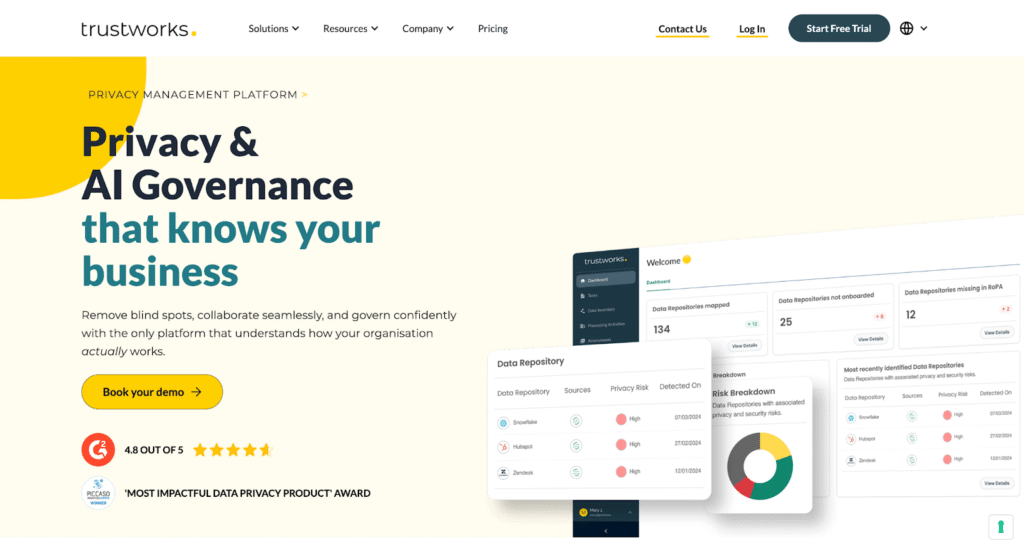
The TrustWorks privacy management platform is designed for teams that want to move beyond static registers and truly operationalise privacy and AI governance. It was built with privacy professionals who run RoPA programs, handle DSRs at scale, coordinate assessments with the business, and support complex, multi-jurisdictional environments.
Instead of treating each activity in isolation, TrustWorks focuses on context. It connects processing activities, vendors, systems, and AI use cases, so privacy teams see how everything fits together and where real risks sit.
Key features
- Real-time data inventory and RoPA, enriched with AI to detect gaps, suggest missing details, and keep records aligned with live systems.
- Data mapping automation, to discover systems and data flows and reduce the manual effort of keeping maps and RoPA up to date.
- AI-assisted assessments for DPIAs, PIAs, TIAs, and AI risk assessments, including templates and workflows that guide stakeholders through what they need to provide.
- TrustWorks Engage, which automatically identifies new business initiatives, routes them into privacy review, and helps avoid shadow projects slipping through.
- Vendor Intelligence gives a clear view of third parties, subprocessors, and related risks in a single vendor risk register.
- AI governance module that can be used on its own or alongside privacy modules, helping track AI systems, risks, and controls without bolting on another siloed tool.
- Collaboration and interoperability, so privacy teams can plug into ticketing, productivity, and security tools instead of asking everyone to learn a new system.
Why it stands out
rustWorks brings together RoPA, data mapping, DSR automation, assessments, vendor risk, and consent management in one privacy automation platform. The focus on context-aware operations helps teams understand not just what they are doing, but why and where it matters most.
It is also one of the first serious alternatives to legacy privacy platforms that dominated the market for years. According to TrustWorks, around 70% of its customers have migrated from an older legacy solution, which says a lot about how well it fits organisations that have hit the limits of their current tool and need a more modern, flexible approach.
It is a strong fit for scale-ups and enterprises that have outgrown spreadsheet-driven compliance and need to coordinate privacy operations with security, product, and engineering without adding more friction.
#2. OneTrust
OneTrust is the established player that has dominated the privacy software market for years, aimed at organisations that want a broad set of privacy, risk, and GRC capabilities in a single ecosystem. It is typically suited to larger budgets and covers areas such as consent and preference management, data governance, privacy automation, security risk, and third-party management.
From a privacy operations perspective, OneTrust can act as a central workspace for RoPA, DPIAs, DSR workflows, and vendor assessments, particularly in organisations with complex internal structures and many business units.
Key features
- Consent and preference management across web, mobile, and connected devices, including banners, preference centres, and notices.
- Privacy automation to standardise recurring workflows and reduce manual follow up for common tasks.
- Governance and risk modules that cover tech risk, security controls, and policy management.
- Third-party management with vendor intake, assessments, ongoing monitoring, and reporting.
- Evidence collection that pulls artefacts from integrated systems to support audits and regulatory inquiries.
- Localisation support to roll out multi-language experiences and region-specific configurations more easily.
Why It Stands Out
For organisations that want a single, integrated suite and are ready to invest in configuring it properly, OneTrust offers extensive coverage across privacy and broader governance needs. It suits larger enterprises that already work with multiple GRC tools and consultancies and want everything pulled into one framework, often with implementation and optimisation supported by a certified consulting partner.
#3. BigID
BigID approaches privacy management from a data intelligence perspective. Its platform focuses on discovering, classifying, and mapping data across structured and unstructured systems, then using that foundation to automate key privacy operations such as RoPA, DPIAs, and DSRs.
This makes it a strong option for organisations that have large, complex data estates and need better visibility into where personal and sensitive data actually lives before they can scale compliant processes.
Key features
- Data discovery and classification that scans on-premises and cloud systems to locate personal and sensitive data.
RoPA and data mapping apps that turn discovered systems and datasets into structured processing records and maps. - DSR and deletion workflows, helping automate the intake, verification, and fulfilment of data subject requests.
- Consent and preference tracking so teams can align usage of data with recorded permissions.
- Regulatory alignment to support GDPR, CPRA, and other global frameworks, including AI-related regulations.
Why it stands out
BigID is particularly relevant if your biggest challenge is not the workflow, but the underlying data sprawl. By strengthening data discovery and classification, it helps privacy and security teams build more reliable RoPA records, respond to DSRs more accurately, and support AI and analytics teams without losing sight of compliance obligations.
#4. Securiti
Securiti positions itself as a Data and AI Command Center, combining privacy, security, and governance capabilities in a single platform. For privacy teams, that means automation around RoPA, assessments, DSRs, and consent, backed by strong data discovery and access governance.
It is suited to organisations that want privacy operations to sit alongside data security and AI governance rather than in a separate silo.
Key features
- PrivacyOps automation for RoPA, DPIAs, PIAs, and other privacy impact assessments, aligned with global regulations.
- Consent automation streamlines how requests are received, verified, and fulfilled.
- Data discovery and classification across hybrid and multi-cloud environments, including unstructured data.
- AI security and governance to map AI systems, monitor usage, and apply controls around sensitive data.
- Vendor assessment tools that help automate third-party privacy and security reviews.
Why it stands out
Securiti is a strong option for teams that see privacy, data security, and AI governance as a connected problem, not separate projects. Its breadth of data governance and AI controls means privacy leaders can align their work with security and data teams using one shared view of risk.
#5. Ketch
Ketch focuses on consent, permissions, and responsible data use. It offers a data permissioning and consent management layer that connects privacy choices with how data is actually collected and used across channels.
For many organisations, Ketch acts as the engine behind user-facing privacy experiences and the policies that govern data access across marketing, product, and analytics.
Key features
- Consent and preference management across websites and applications, including cookie and tracker control.
- Progressive consent, embedding privacy choices contextually into user journeys rather than relying on one-off, interruptive prompts.
- DSR intake to fulfilment automation using no-code workflows, which helps non-technical teams manage requests.
- Customisable banners and preference centres with hundreds of layouts and multi-language options.
Why it stands out
Ketch is a good fit for organisations that place a premium on user experience and want privacy choices to feel natural, while still enforcing those choices consistently in the background. Its focus on progressive consent and data permissioning supports both privacy compliance and marketing teams’ need for reliable, permissioned data.
Final thoughts
The best privacy management platform for your organisation is the one that fits your operating reality, not just your policy framework. As you evaluate tools, look at how they handle the work you actually do every week, from maintaining RoPA and running DPIAs, to keeping vendor assessments moving and clearing DSR backlogs without burning out the team.
Among the platforms mentioned here, TrustWorks stands out for how it delivers privacy automation in complex, multilingual, and multi-jurisdictional environments where many teams still struggle. Its AI-powered, context-aware operations help adapt each workflow to the relevant legislative, organisational, and regional context, which is repeatedly highlighted in customer reviews and case studies.
If you are looking for a platform that combines strong privacy management with optional AI governance, and that can plug into the way your organisation already works, TrustWorks is a compelling place to start your shortlist.
- privacy