
How To Improve Solar Operations?

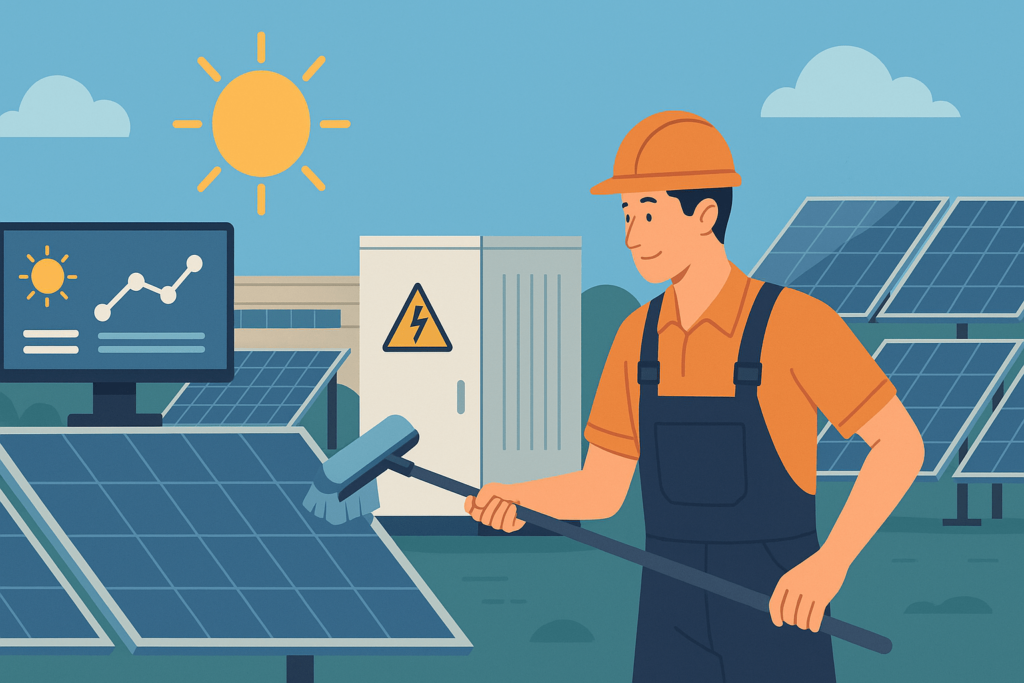
Improving solar operations requires a strategic approach focused on maintenance, technology integration, and financial optimization. You can boost your system’s performance through regular panel cleaning, component checks, and preventive maintenance that catches issues before they cause significant downtime or damage.
Managing a solar installation comes with unique challenges, but with the right knowledge and tools, you can maximize both energy production and financial returns. This guide provides practical solutions to common operational hurdles that solar system owners face.
Solar Operations and Maintenance (O&M) Systems
What Is a Solar O&M System?
A solar Operations and Maintenance (O&M) system is the framework used to manage, monitor, and maintain a solar installation throughout its operational life. It centralizes performance data, maintenance activities, and system diagnostics to ensure that all components work together efficiently.
Instead of addressing issues only after failures occur, an O&M system enables proactive oversight that helps maintain consistent energy production and system reliability.
Modern platforms, such as the solar O&M system by Scoop, bring these capabilities into a single, unified interface.
By integrating monitoring tools, analytics platforms, and maintenance workflows, solar O&M systems provide clear visibility into asset health and operational performance. This structured approach supports informed decision-making and allows system owners to optimize both technical performance and long-term financial returns.
How Solar O&M Systems Improve Performance and Reliability?
Solar O&M systems improve performance by continuously tracking system output and identifying inefficiencies early. Integrated monitoring and analytics detect underperforming panels, inverter anomalies, connection issues, and environmental impacts before they lead to significant energy losses. Early detection allows maintenance teams to resolve problems quickly and minimize downtime.
From a reliability standpoint, O&M systems support predictive and scheduled maintenance strategies that extend equipment lifespan and reduce unexpected outages. Maintenance alerts, historical performance analysis, and structured service planning help operators maintain high system availability while controlling operational costs.
Together, these capabilities create a stable foundation for advanced optimization technologies and smart management strategies covered in the following sections.
Ensuring Financial Viability
Reducing Downtime
Downtime represents a direct financial loss for your solar operations. Every hour your system sits idle means lost electricity generation and revenue. The good news? You can significantly minimize this impact through strategic planning.
Regular inspections allow you to catch potential issues before they cause failures. Implementing remote monitoring systems gives you real-time alerts about performance drops, letting your team respond quickly to emerging problems.
Weather-related downtime can be managed with accurate forecasting tools that help prepare your operations for upcoming conditions. Having critical spare parts on-site reduces repair wait times dramatically.
Many solar operators find that creating a detailed maintenance calendar with scheduled service intervals keeps systems running optimally. This approach transforms maintenance from reactive emergency responses into planned activities that cause minimal disruption.
Financial benefits extend beyond just avoiding lost generation, your equipment lasts longer when properly maintained, postponing expensive replacement costs and improving your overall return on investment.
Strategies For Proactive Maintenance
Proactive maintenance puts you in control rather than leaving your operation at the mercy of unexpected breakdowns. Start by establishing baseline performance metrics for your solar assets, so deviations can be quickly identified.
Thermal imaging inspections can detect hot spots on panels before they fail completely. Data analytics help predict component failures based on performance patterns, allowing replacement before breakdown occurs.
Consider implementing these practical approaches:
- Schedule panel cleaning during low-production periods
- Use predictive analytics to forecast maintenance needs
- Perform regular connector and wiring inspections
- Monitor inverter performance daily
- Conduct vegetation management before overgrowth affects panels
Your maintenance team should document all activities in detail, building a history that helps identify recurring issues. This documentation becomes valuable for spotting patterns and refining your maintenance strategy over time.
Proactive approaches might require more upfront planning but deliver substantial savings by preventing emergency repair premiums and extending equipment life.
ROI And Long-Term Savings
Effective solar O&M directly impacts your financial returns. A well-maintained solar facility typically produces more energy over its lifetime compared to poorly maintained systems.
Data-driven insights allow you to make informed decisions about performance optimization. For example, analyzing production patterns might reveal that certain panels consistently underperform and should be prioritized for cleaning or replacement.
Intelligent operations include optimizing maintenance schedules around weather patterns and electricity pricing. This approach maximizes generation during high-value periods and schedules maintenance during low-value times.
Your long-term financial planning should account for the value of preventative maintenance. While it requires ongoing investment, this approach typically delivers 2–3 times return through avoided emergency repairs and extended equipment life.
Compliance And Safety
Safety regulations exist to protect both your workers and your investment. Regular maintenance activities help ensure your solar operations remain compliant with local and national requirements.
Electrical safety inspections should check for proper grounding, wire integrity, and connection security. These checks prevent potential fire hazards and electrical accidents that could result in injuries, system damage, or regulatory penalties.
Your maintenance program must include documentation of all safety procedures and completed inspections. This record-keeping proves compliance during regulatory audits and can reduce liability in case of incidents.
Personal protective equipment requirements need clear definition for all maintenance activities. Workers should receive proper training on electrical safety, fall protection, and heat stress management.
Many solar operators develop a comprehensive safety manual specific to their facilities. This resource becomes valuable for training new staff and ensuring consistent safety practices across all maintenance activities.
Innovations that will transform solar operations
Solar Tracking Systems For Greater Efficiency
Solar tracking technology allows panels to follow the sun’s path throughout the day, maximizing direct exposure to sunlight. This dynamic approach can significantly increase energy harvest compared to fixed-tilt installations.
Two primary tracking approaches exist in today’s market:
Single-axis trackers rotate panels along one axis, typically oriented north-south, allowing east-to-west tracking throughout the day. This relatively simple mechanism can boost energy production by 15-25% compared to fixed systems. The mechanical simplicity translates to lower maintenance requirements and costs.
Dual-axis trackers adjust both the east-west orientation and the tilt angle, allowing panels to maintain perfect perpendicular alignment with incoming sunlight regardless of season or time of day. This more complex approach can increase yields by 30-45% but comes with higher installation and maintenance costs.
The economics of tracking systems vary by location. Regions with high direct sunlight benefit most, while areas with significant diffuse light (common in cloudy climates) see reduced advantages. The cost-benefit analysis must consider:
- Local electricity rates and incentives
- Land availability and cost
- Local labor rates for installation and maintenance
- Wind load requirements
Modern tracking systems incorporate sophisticated control algorithms that can:
- Respond to weather conditions, stowing panels during high winds
- Optimize angles during partial cloud cover
- Reduce row-to-row shading in large installations
- Implement backtracking strategies during early morning and late afternoon
For utility-scale projects, single-axis tracking has become the dominant configuration in many markets due to its favorable economics. The additional energy production often outweighs the incremental cost, especially as tracker prices have declined and reliability has improved.
Data Analytics And AI-Driven O&M
The digital transformation of solar operations and maintenance has created unprecedented opportunities for performance optimization. Advanced monitoring systems now collect thousands of data points from solar assets, creating rich datasets for analysis.
Machine learning algorithms can detect subtle performance deviations before they become major issues. By establishing baseline performance expectations and continuously comparing actual output against predicted values, these systems flag anomalies that might indicate developing problems. This predictive approach allows you to address issues before they cause significant production losses.
Drone technology paired with thermal imaging has revolutionized inspection processes. What once required days of manual inspection can now be completed in hours, with greater accuracy and safety. AI-powered image analysis automatically identifies hot spots, cell cracks, and other defects from thermal scans.
Weather forecasting integration helps optimize maintenance scheduling and production planning. Advanced systems can predict output based on weather patterns and adjust maintenance activities to minimize production impact.
Remote monitoring platforms now provide comprehensive visibility across distributed assets. Fleet managers can view performance metrics, compare similar systems, and prioritize maintenance activities based on financial impact rather than simply responding to failures.
The benefits of AI-driven solar O&M include:
- Reduced truck rolls through better diagnostic capabilities
- Lower operational costs through optimized maintenance scheduling
- Extended equipment life through early intervention
- Improved financial performance through higher system availability
As solar portfolios grow, these digital tools become increasingly valuable. The ability to manage hundreds or thousands of distributed systems efficiently requires automation and intelligence that manual processes cannot provide.
- Cyber Security